"The Red Planet"
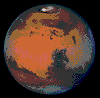
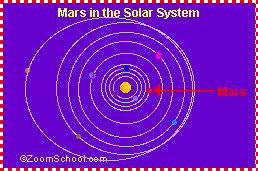 Mars, the red planet, is the fourth planet from the sun and the most Earth-like planet in our solar system. It is about half the size of Earth and has a dry, rocky surface and a very thin atmosphere.
MARS' SURFACE
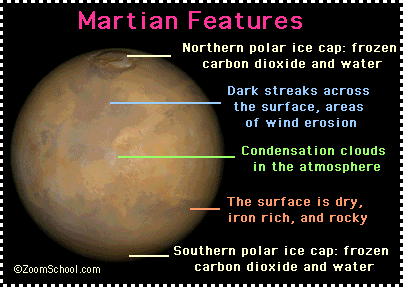
The surface of Mars is dry, rocky, and mostly covered with iron-rich dust. There are low-lying plains in the northern hemisphere, but the southern hemisphere is dotted with impact craters. The ground is frozen; this permafrost extends for several kilometers.
The north and south poles of Mars are covered by ice caps composed of frozen carbon dioxide and water.
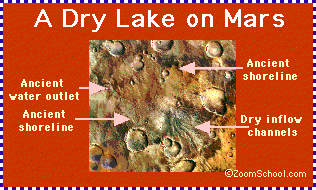 Scientists have long thought that there is no liquid water on the surface of Mars now, but recent photos from Mars indicate that there might be some liquid water near the surface. The surface of Mars shows much evidence of the effects of ancient waterways upon the landscape; there are ancient, dry rivers and lakes complete with huge inflow and outflow channels. These channels were probably caused by catastrophic flooding that quickly eroded the landscape.
Scientists think that most of the water on Mars is frozen in the land (as permafrost) and frozen in the polar ice caps.
G. Schiaparelli was an Italian astronomer who first mapped Mars (in 1877) and brought attention to the network of "canali" (Italian for canals or channels) on Mars. These "canals" were later found to be dry and not to be canals at all. A Martian impact crater (Crater Schiaparelli, 461 km = 277 mi in diameter) and a hemisphere of Mars have been named after Schiaparelli.
SIZE
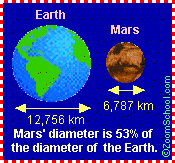 Mars is about 4,222 miles (6790 km) in diameter. This is 53% (a little over half) of the diameter of the Earth.
PLANETARY COMPOSITION
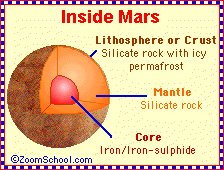 Crust and Surface: Mars' surface is composed mostly of iron-rich basaltic rock (an igneous rock). Mars has a thin crust, similar to Earth's.
Mantle: Silicate rock, probably hotter than the Earth's mantle at corresponding depths.
Core: The core is probably iron and sulphides and may have a radius of 800-1,500 miles (1,300-2,400 km). More will be known when data from future Mars missions arrives and is analyzed.
MASS AND GRAVITY
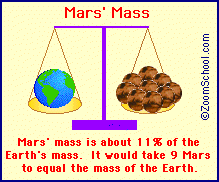 Mars' mass is about 6.42 x 10^23 kg. This is 1/9th of the mass of the Earth. A 100-pound person on Mars would weigh 38 pounds.
LENGTH OF A DAY AND YEAR ON MARS
 Each day on Mars takes 1.03 Earth days (24.6 hours). A year on Mars takes 687 Earth days; it takes this long for Mars to orbit the sun once.
MARS' ORBIT
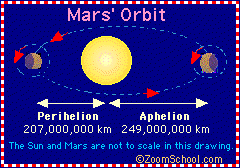 Mars is 1.524 times farther from than the sun than the Earth is. It averages 141.6 million miles (227.9 million km) from the sun. Its orbit is very elliptical; Mars has the highest orbital eccentricity of any planet in our Solar System except Pluto.
ATMOSPHERE
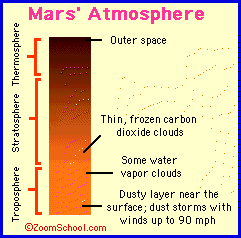 Mars has a very thin atmosphere. It consists of 95% carbon dioxide (CO2), 3% nitrogen, and 1.6% argon (there is no oxygen). The atmospheric pressure is only a fraction of that on Earth (about 1% of Earth's atmospheric pressure at sea level), and it varies greatly throughout the year. There are large stores of frozen carbon dioxide at the north and south poles. During the warm season in each hemisphere, the polar cap partly melts, releasing carbon dioxide. During the cold season in each hemisphere, the polar cap partly freezes, capturing atmospheric carbon dioxide.
The atmospheric pressure varies widely from season to season; the global atmospheric pressure on Mars is 25% different (there is less air, mostly carbon dioxide) during the (northern hemisphere) winter than during the summer. This is mostly due to Mars' highly eccentric orbit; Mars is about 20% closer to the Sun during the winter than during the summer. Because of this, the northern polar cap absorbs more carbon dioxide than the southern polar cap absorbs half a Martian year later.
Occasionally, there are clouds in Mars' atmosphere. Most of these clouds are composed of carbon dioxide ice crystals or, less frequently, of frozen water crystals.
There are a lot of fine dust particles suspended in Mars' atmosphere. These particles (which contain a lot of iron oxide) absorb blue light, so the sky appears to have little blue in it and is pink/yellow to butterscotch in color.
 TEMPERATURE RANGE
Mars' surface temperature averages -81 °F (-63 °C). The temperature ranges from a high of 68° F(20° C) to a low of -220° F(-140° C). Mars is much colder than the Earth.
MARS' MOONS
Mars has 2 tiny moons, Phobos and Deimos. They were probably asteroids that were pulled into orbit around Mars.
SPACECRAFT VISITS
Mariner 4 was the first spacecraft to visit Mars (in 1965). Two Viking spacecraft landed in 1976. Mars Pathfinder landed on Mars on July 4, 1997, broadcasting photos.
THE FACE ON MARS
 This photograph of the Cydonia Mense region of Mars was taken by NASA's Mars Global Surveyor in 1998. It is a coincidental alignment of rocks and other geologic formations that happens to look like a human face from this angle.
DISCOVERY OF MARS
 Mars has been known since ancient times.
MARS' NAME AND SYMBOL
Mars was named after the Roman god of war.
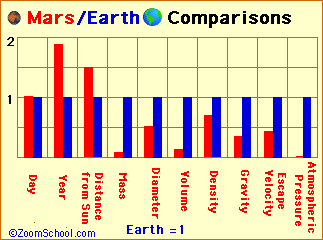
STATISTICS ON MARS
They are both small moons; Phobos is 13.8 miles (22.2 km) across and Deimos is only 7.8 miles (12.6 km) across.
These moons are heavily-cratered and are composed of rock and iron. They are probably former asteroids that were captured by Mars' gravitational field. They have no atmosphere.
Mars, the red planet, is the fourth planet from the sun and the most Earth-like planet in our solar system. It is about half the size of Earth and has a dry, rocky surface and a very thin atmosphere. MARS' SURFACE
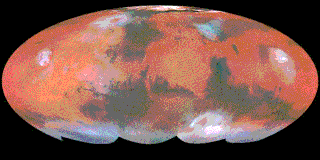 A Mollweide projection of Mars made from four pictures taken by Hubble Space Telescope in 1999. A storm is visible in the top left near the pole. |
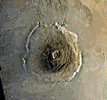 Olympus Mons, the largest volcano on Mars; it is perhaps the largest volcano in the Solar System. It is 17 miles (27 km) tall and over 320 miles (520 km) across. It is thought to be extinct. |
Scientists have long thought that there is no liquid water on the surface of Mars now, but recent photos from Mars indicate that there might be some liquid water near the surface. The surface of Mars shows much evidence of the effects of ancient waterways upon the landscape; there are ancient, dry rivers and lakes complete with huge inflow and outflow channels. These channels were probably caused by catastrophic flooding that quickly eroded the landscape. Scientists think that most of the water on Mars is frozen in the land (as permafrost) and frozen in the polar ice caps.
G. Schiaparelli was an Italian astronomer who first mapped Mars (in 1877) and brought attention to the network of "canali" (Italian for canals or channels) on Mars. These "canals" were later found to be dry and not to be canals at all. A Martian impact crater (Crater Schiaparelli, 461 km = 277 mi in diameter) and a hemisphere of Mars have been named after Schiaparelli.
SIZE
Mars is about 4,222 miles (6790 km) in diameter. This is 53% (a little over half) of the diameter of the Earth. PLANETARY COMPOSITION
Crust and Surface: Mars' surface is composed mostly of iron-rich basaltic rock (an igneous rock). Mars has a thin crust, similar to Earth's. Mantle: Silicate rock, probably hotter than the Earth's mantle at corresponding depths.
Core: The core is probably iron and sulphides and may have a radius of 800-1,500 miles (1,300-2,400 km). More will be known when data from future Mars missions arrives and is analyzed.
MASS AND GRAVITY
Mars' mass is about 6.42 x 10^23 kg. This is 1/9th of the mass of the Earth. A 100-pound person on Mars would weigh 38 pounds. LENGTH OF A DAY AND YEAR ON MARS
Each day on Mars takes 1.03 Earth days (24.6 hours). A year on Mars takes 687 Earth days; it takes this long for Mars to orbit the sun once. MARS' ORBIT
Mars is 1.524 times farther from than the sun than the Earth is. It averages 141.6 million miles (227.9 million km) from the sun. Its orbit is very elliptical; Mars has the highest orbital eccentricity of any planet in our Solar System except Pluto. ATMOSPHERE
Mars has a very thin atmosphere. It consists of 95% carbon dioxide (CO2), 3% nitrogen, and 1.6% argon (there is no oxygen). The atmospheric pressure is only a fraction of that on Earth (about 1% of Earth's atmospheric pressure at sea level), and it varies greatly throughout the year. There are large stores of frozen carbon dioxide at the north and south poles. During the warm season in each hemisphere, the polar cap partly melts, releasing carbon dioxide. During the cold season in each hemisphere, the polar cap partly freezes, capturing atmospheric carbon dioxide. The atmospheric pressure varies widely from season to season; the global atmospheric pressure on Mars is 25% different (there is less air, mostly carbon dioxide) during the (northern hemisphere) winter than during the summer. This is mostly due to Mars' highly eccentric orbit; Mars is about 20% closer to the Sun during the winter than during the summer. Because of this, the northern polar cap absorbs more carbon dioxide than the southern polar cap absorbs half a Martian year later.
Occasionally, there are clouds in Mars' atmosphere. Most of these clouds are composed of carbon dioxide ice crystals or, less frequently, of frozen water crystals.
There are a lot of fine dust particles suspended in Mars' atmosphere. These particles (which contain a lot of iron oxide) absorb blue light, so the sky appears to have little blue in it and is pink/yellow to butterscotch in color.
TEMPERATURE RANGEMars' surface temperature averages -81 °F (-63 °C). The temperature ranges from a high of 68° F(20° C) to a low of -220° F(-140° C). Mars is much colder than the Earth.
MARS' MOONS
Mars has 2 tiny moons, Phobos and Deimos. They were probably asteroids that were pulled into orbit around Mars.
SPACECRAFT VISITS
Mariner 4 was the first spacecraft to visit Mars (in 1965). Two Viking spacecraft landed in 1976. Mars Pathfinder landed on Mars on July 4, 1997, broadcasting photos.
THE FACE ON MARS
This photograph of the Cydonia Mense region of Mars was taken by NASA's Mars Global Surveyor in 1998. It is a coincidental alignment of rocks and other geologic formations that happens to look like a human face from this angle. DISCOVERY OF MARS
Mars has been known since ancient times. MARS' NAME AND SYMBOL
 This is the symbol of the planet Mars. |
| MARS STATISTICS |
 | |
|---|---|
| Distance from Sun | 1.524 AU 141.6 million miles 227.9 million km |
| Diameter | 4,222 miles 6,787 km |
| Mass | 6.42 x 10²³ About 1/9 of Earth |
| Number of Moons | 2 |
| 1 Martian Day (Period of Rotation) | 24.6 Earth hours 1.026 Earth days |
| 1 Martian Year (Period of Revolution Around the Sun) | 686.98 Earth days |
| Escape Velocity | 5,000 m/sec |
| Average Temperature | -9 °F -23 °C |
| Temperature Range | 150-310 K |
| Albedo (reflectivity) | 0.15 |
| Density | 3,940 kg/m3 |
| Apparent Size from Earth | 4-25 arc seconds |
| Oblique Axis (Tile of the Axis) | 25° |
| Orbital Inclination | 1.85° |
| Orbital Eccentricity (Deviation from circular) | 0.093 |
| Perihelion closest to sun | 1.38 AU |
| Aphelion farthest from sun | 1.67 AU |
THE MOONS OF MARS
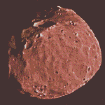
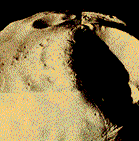
Mars has two moon, Phobos and Deimos. They were discovered by the American astronomer Asaph Hall (1829-1907) in 1877. They are both small moons; Phobos is 13.8 miles (22.2 km) across and Deimos is only 7.8 miles (12.6 km) across.
These moons are heavily-cratered and are composed of rock and iron. They are probably former asteroids that were captured by Mars' gravitational field. They have no atmosphere.

| Missions to Mars |
Mariner 4 was the first spacecraft to visit Mars in 1965. The first spacecraft orbited on Mars in 1971. The first spacecraft landed on Mars in 1976.
| Missions | Date | Accomplishment |
|---|---|---|
| Mariner 4 | 1965 | Fly-by mission: photos transmitted |
| Mariner 6 and 7 | 1969 | Fly-by mission: atmosphere examined |
| Mariner 9 | 1971 | Orbiter: First orbiter around another planet- mapping mission |
| Viking 1 and 2 | 1976 | Lander: surface photos, soil biochemistry investigated. Orbiter: global mapping from orbit. |
| Phobos 2 | 1989 | Orbiter: photos of Phobos |
| Mars Pathfinder | 1997 | Lander: (the first bouncing landing) plus "Sojourner" roving vehicle which performed rock analysis, |
 Mars Global Surveyor Mars Global Surveyor | 1997 | Orbiter: examine surface features, atmosphere, and magnetic properties. |
| Mars Climate Orbiter (NASA) | 1998 | Orbiter: study Martian weather and climate. |
| Mars Polar Lander (NASA) | 1999 | Lander: study soil and meteorology near Mars South Pole. |
| Mars Surveyor 2001 Orbiter (NASA) | March, 2001 | Orbiter: study Mars from orbit, test aerocapture techniques, and act as a communications relay for the upcoming lander (see next entry). |
| Mars Surveyor 2001 Lander (NASA) | April, 2001 | Lander: To bring the remote-controlled rover "Athena" to the surface, which will continue studying the Martian surface. |
| Mars Surveyor 2003 Orbiter (NASA) | 2003-2004 | Orbiter: study Mars from orbit, and serve as communications relay for the lander (see next entry) |
| Mars Surveyor 2003 Lander (NASA) | 2003-2004 | Lander: Brought the remote-controlled rover (Spirit) to the surface, which will continue studying the Martian surface. |


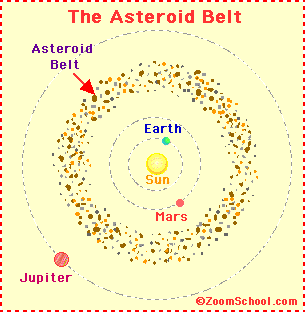 The asteroid belt is a doughnut-shaped concentration of asteroids orbiting the Sun between the orbits of Mars and Jupiter, closer to the orbit of Mars. Most asteroids orbit from between 186 million to 370 million miles (300 million to 600 million km or 2 to 4 AU) from the Sun. The asteroids in the asteroid belt have a slightly elliptical orbit. The time for one revolution around the Sun varies from about three to six Earth years.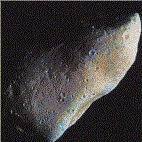
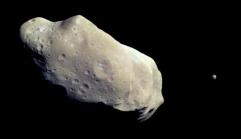
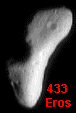

 There are some asteroids that have orbits outside the asteroid belt. Some have orbits that cross the orbit of the Earth, and some have hit the Earth. A large asteroid could survive the trip trough Earth's atmosphere (called a meteor during its trip through the atmosphere) and form an impact crater.
  An asteroid impact with the Earth may have caused the extinction of the dinosaurs. The Alvarez Asteroid Theory explains the huge K-T mass extinction 65 million years ago by a large asteroid hitting the Earth off the Mexican Yucatan peninsula. This impact would have caused severe climactic changes leading to the demise of many groups of organisms, including non-avian dinosaurs.
  , pterosaurs
 , plesiosaurs, mosasaurs, ammonites, some families of birds and marsupial mammals, over half the plankton groups, many families of teleost (bony) fishes, bivalves, snails, sponges, sea urchins and others.
  4-9 miles (6-15 km) in diameter hit the Earth
  about 65 million years ago. The impact would have penetrated the Earth's crust, scattering dust and debris into the atmosphere, and causing huge fires, volcanic activity
  , tsunamis
 , and severe storms with high winds
 and highly acidic rain
  . The impact could have caused chemical changes in the Earth's atmosphere, increasing concentrations of sulfuric acid, nitric acid, and fluoride compounds. The heat from the impact's blast wave would have incinerated all the life forms in its path.
  for months, and lowered the temperature
  globally.
  - Tektites are quartz grains which are vaporized under intense heat and pressure, and cool into glass beads with no crystalline structure. Tektites were probably formed during a meteorite or comet collision. Tektites are abundant in the K-T layer.